
CBSE Class 10 Maths: Syllabus Overview, Sample Papers & PYQs.
 Nipender Singh •03 Feb 2026
CBSE Class 10 Maths
When we talk about Higher education, class 10 is the first step to solving real-life problems through algebraic methods, trigonometry and logical analysis. And often students do not understand and fall into the trap of memorizing everything. CBSE curriculum focuses on the application of mathematical concepts to solve real-life problems, not to just remember the formula and start attempting questions. If you are a class 10 student and struggling to understand class 10th maths then In this blog you will clear all your doubts regarding the entire syllabus, Exam pattern, study resources and strategy.
Scoring the perfect 100 isn’t just hard work, it’s strategic preparation and here Learnic expert teachers can help you to prepare customized strategies based on your needs. Learnic prepares a full length CBSE class 10 maths course covering all the topics with detailed explanation.
Additional Information: Last year 2025 a total of 24,12,072 students registered for class 10 board exams and this year 2026 total of 26,60,000 students registered. You can imagine the competition also students are often confused about CBSE and NCERT. Let me clear your doubts. CBSE is the national board that gives authority to schools (technically called affiliation). NCERT is a government body that develops educational materials, frameworks and text books for CBSE affiliated schools. This means NCERT creates the course, books and required content and CBSE makes sure that every school implements that and conducts exams. CBSE stands for Central board of Secondary Education and NCERT stands for National council of Education Research Training. You can visit official website of CBSE and NCERT.
CBSE Maths Syllabus for Class 10
The syllabus of maths for class 10 covers major 7 Units and if you properly practice these 7 major topics you will be able to score 100% marks in your board exam. These major units are Number system, Algebra, Coordinate Geometry, Geometry, Trigonometry, Mensuration and Statistics & Probability. Here is a detailed table which will help you to understand these topics, key focus area and the weightage. Your preparation strategy can be based on this table. You can cover those units first which have maximum weightage. Or you can finish easy ones who have small weightage then completely focus on big ones.
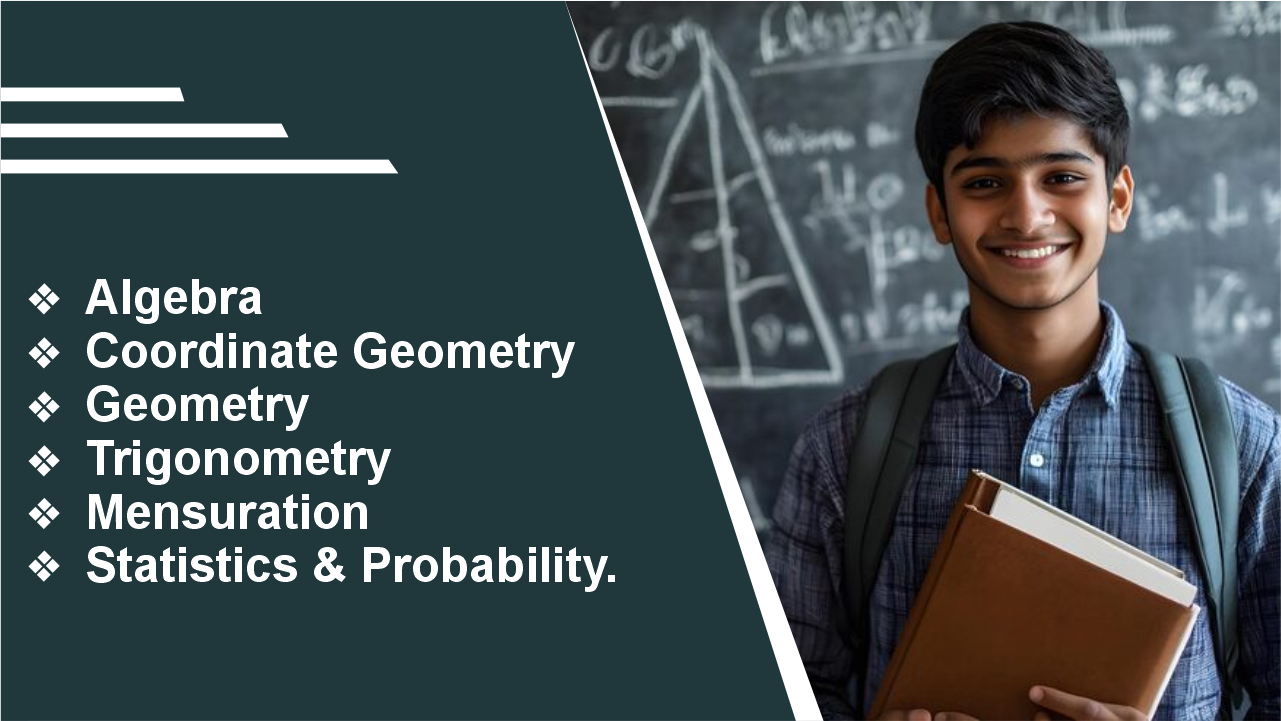
CBSE Class 10 Maths Unit-wise Marks weightage.
Unit | Topic | Marks | Key Focus Areas |
I | Number Systems | 06 | Focus on the Fundamental Theorem of Arithmetic |
II | Algebra | 20 | Polynomials: Zeros and relationships between zeros and coefficients. Linear Equations: Graphical methods and algebraic methods (substitution, elimination). Quadratic Equations: Factorization, quadratic formula, and discriminant nature. AP: Derivation of the nth term and sum of n terms. |
III | Coordinate Geometry | 06 | Distance formula and Section formula (internal division) |
IV | Geometry | 15 | Similarity of triangles (Basic Proportionality Theorem) and Circles (tangents and properties) |
V | Trigonometry | 12 | Trigonometric ratios (30°, 45°, 60°), identities (sin²A + cos²A = 1), Heights and Distances. |
VI | Mensuration | 10 | Areas related to circles (sectors/segments) and Surface Areas & Volumes of combined solids |
VII | Statistics & Probability | 11 | Highlight that bimodal situations are to be avoided and focus is on Mean, Median, and Mode of grouped data. classical definition of probability. |
| Internal Assessment | 20 Marks |
| Pen Paper Test and Multiple Assessment (5+5) | 10 Marks |
| Portfolio | 05 Marks |
| Lab Practical (Lab activities to be done from the prescribed books) | 05 Marks |
Class 10 Maths Book – NCERT Overview
A question we hear again and again in Learnic’s live classes: Is NCERT sufficient to score well in the CBSE Class 10 Maths board exam?
Yes, absolutely, NCERT textbook is more than enough to prepare for the CBSE class 10 maths board exam. However, consistent practice is highly recommended to build strong concepts and you will find the maths test series by learnic. Now if we look at the index of NCERT books used in CBSE class 10 maths class then you will observe that all the topics covered in the book are sufficient enough to give you the idea of what will be asked in the board exam.

The NCERT textbook is certainly sufficient for preparing for the CBSE Class 10 Maths board exam. However, consistent practice is highly recommended to solidify concepts; you may find resources like the maths test series by learnic helpful. Examining the index of the NCERT book reveals that all the topics necessary for understanding what will be asked in the board exam are covered. Let us go through the index and see which chapter is important based on unit wise weightage that I shared above.
Chapter Number | Chapter Name / Topic | Page Number |
1 | Real Numbers | 1 |
1.1 Introduction | 1 | |
1.2 The Fundamental Theorem of Arithmetic | 2 | |
1.3 Revisiting Irrational Numbers | 6 | |
1.4 Summary | 9 | |
2 | Polynomials | 10 |
2.1 Introduction | 10 | |
2.2 Geometrical Meaning of the Zeroes of a Polynomial | 11 | |
2.3 Relationship between Zeroes and Coefficients of a Polynomial | 18 | |
2.4 Summary | 23 | |
3 | Pair of Linear Equations in Two Variables | 24 |
3.1 Introduction | 24 | |
3.2 Graphical Method of Solution of a Pair of Linear Equations | 25 | |
3.3 Algebraic Methods of Solving a Pair of Linear Equations | 30 | |
3.3.1 Substitution Method | 30 | |
3.3.2 Elimination Method | 34 | |
3.4 Summary | 37 | |
4 | Quadratic Equations | 38 |
4.1 Introduction | 38 | |
4.2 Quadratic Equations | 39 | |
4.3 Solution of a Quadratic Equation by Factorisation | 42 | |
4.4 Nature of Roots | 44 | |
4.5 Summary | 47 | |
5 | Arithmetic Progressions | 49 |
5.1 Introduction | 49 | |
5.2 Arithmetic Progressions | 51 | |
5.3 nth Term of an AP | 56 | |
5.4 Sum of First n Terms of an AP | 63 | |
5.5 Summary | 72 | |
6. | Triangles | 73 |
6.1 Introduction | 73 | |
6.2 Similar Figures | 74 | |
6.3 Similarity of Triangles | 79 | |
6.4 Criteria for Similarity of Triangles | 85 | |
6.5 Summary | 97 | |
7. | Coordinate Geometry | 99 |
7.1 Introduction | 99 | |
7.2 Distance Formula | 100 | |
7.3 Section Formula | 106 | |
7.4 Summary | 112 | |
8. | Introduction to Trigonometry | 113 |
8.1 Introduction | 113 | |
8.2 Trigonometric Ratios | 114 | |
8.3 Trigonometric Ratios of Some Specific Angles | 121 | |
8.4 Trigonometric Identities | 128 | |
8.5 Summary | 132 | |
9. | Some Applications of Trigonometry | 133 |
9.1 Heights and Distances | 133 | |
9.2 Summary | 143 | |
10. | Circles | 144 |
10.1 Introduction | 144 | |
10.2 Tangent to a Circle | 145 | |
10.3 Number of Tangents from a Point on a Circle | 147 | |
10.4 Summary | 153 | |
11. | Areas Related to Circles | 154 |
11.1 Areas of Sector and Segment of a Circle | 154 | |
11.2 Summary | 160 | |
12. | Surface Areas and Volumes | 161 |
12.1 Introduction | 161 | |
12.2 Surface Area of a Combination of Solids | 162 | |
12.3 Volume of a Combination of Solids | 167 | |
12.4 Summary | 170 | |
13. | Statistics | 171 |
13.1 Introduction | 171 | |
13.2 Mean of Grouped Data | 171 | |
13.3 Mode of Grouped Data | 183 | |
13.4 Median of Grouped Data | 188 | |
13.5 Summary | 200 | |
14. | Probability | 202 |
14.1 Probability — A Theoretical Approach | 202 | |
14.2 Summary | 217 |
CBSE Maths Exam Pattern for Class 10
The maths exam pattern shows the type of question asked, marks per question and how the total marks are distributed among chapters/units we discussed in above sections. Understanding this format will help students to plan their exam strategy and manage their time effectively.
Type of Question | Marks per Question | Total No. of Questions | Total Marks |
MCQ (Multiple Choice Questions) | 1 | 10 | 10 |
VSA (Very Short Answer) | 2 | 8 | 16 |
SA (Short Answer) | 3 | 10 | 30 |
LA (Long Answer) | 4 | 6 | 24 |
TOTAL | — | — | 80 |
The paper includes both objective and subjective questions. MCQs test your concepts, short answer and long answer question format evaluate your problem-solving, writing skills, presentation skills etc.
Here is a short blueprint of the exam shared by CBSE. Unit-wise and question-type-wise distribution of marks. You can clearly see the weight and how different type of questions are spread across the syllabus.
Units | MCQ (1) | SA-I (2) | SA-II (3) | LA (4) | Total |
Algebra | 2(2) | 4(2) | 6(2) | 8(2) | 20(8) |
Geometry | 4(4) | 2(1) | 6(2) | 4(1) | 16(8) |
Mensuration | 2(2) | 4(2) | 6(2) | 8(2) | 20(8) |
Trigonometry | 1(1) | – | 3(1) | 4(1) | 8(3) |
Coordinate Geometry | – | 4(2) | 6(2) | – | 10(4) |
Probability | 1(1) | 2(1) | 3(1) | – | 6(3) |
TOTAL | 10(10) | 16(8) | 30(10) | 24(6) | 80(34) |
CBSE Class 10th Sample Papers
The Learnic Team has prepared a few sample papers to help you test and consolidate your knowledge right before the exam. These papers are available for free download and practice.
CBSE Class 10th Exam Time Table
This timetable below will help you to keep track of exam dates, days and timings for each subject that you opt for. Even if you have already seen it on the official website or from your school, I am sharing it again for quick and easy reference.
Key things to keep in mind
Maintain a personal copy
Plan your revision
Adhere to reporting times
Subject | Day – Date | Timings |
Mathematics – Standard Mathematics – Basic | 17th Feb 2026 – Tuesday | 10:30 AM – 1:30 PM |
Home Science | 18th Feb 2026 – Wednesday | 10:30 AM – 1:30 PM |
Beauty & Wellness Marketing & Sales Multimedia Multi Skill Foundation Course Physical Activity Trainer Data Science | 20th Feb 2026 – Thursday | 10:30 AM – 12:30 PM |
English (Communicative) English (Language & Literature) | 21st Feb 2026 – Friday | 10:30 AM – 1:30 PM |
Urdu Course – A Punjabi Bengali Tamil Marathi Gujarati Manipuri Telugu – Telangana | 23rd Feb 2026 – Monday | 10:30 AM – 1:30 PM |
Elements of Business Urdu Course – B | 24th Feb 2026 – Tuesday | 10:30 AM – 1:30 PM |
Science | 25th Feb 2026 – Wednesday | 10:30 AM – 1:30 PM |
Retail Security Automotive Introduction to Financial Markets Introduction to Tourism Agriculture Food Production Front Office Operations Banking & Insurance Health Care Apparel Electronics & Hardware Foundation Skill for Sciences – Design Thinking & Innovation Design Thinking and Innovation | 26th Feb 2026 – Thursday | 10:30 AM – 12:30 PM |
Computer Applications Information Technology Artificial Intelligence | 27th Feb 2026 – Friday | 10:30 AM – 12:30 PM |
Arabic Sanskrit Rai Gurung Tamang Sherpa | 28th Feb 2026 – Saturday | 10:30 AM – 1:30 PM |
Hindi Course – A | 2nd March 2026 – Monday | 10:30 AM – 1:30 PM |
Sindhi Malayalam Odia Assamese Kannada Kokborok | 5th March 2026 – Thursday | 10:30 AM – 1:30 PM |
Painting | 6th March 2026 – Friday | 10:30 AM – 12:30 PM |
Social Science | 7th March 2026 – Saturday | 10:30 AM – 1:30 PM |
References and source of information

Written by
Nipender Singh
Frequently Asked Questions
Find answers to your questions & more.
20 marks
No, as per the syllabus update it clearly states that “bimodal situation will be avoided in exams.