
7 Signs Your Child Needs Extra Academic Support
 Niranjan Sharma •10 Apr 2026
Your child comes home, throws the bag and says nothing. He is also having dinner quietly. When you are trying to connect and try to ask about school and studies and they simply say “fine”. But something feels off. This is a situation where parents have to react calmly and show some patience. By acting smartly parents can help your child to succeed in academic. Let them settle down and ask them to sleep. When they wake up, then have a discussion with them.
In most of the cases serious students (who are worried about their studies) feel demotivated when they fall behind from their classmates. I am not denying that there can be many other reasons and let me try to list them all. After that will find out when your child really needs academic support. Here are 7 signs to watch for, and what to do when you spot them.
#Sign1: Low Confidence and Negative self-talk
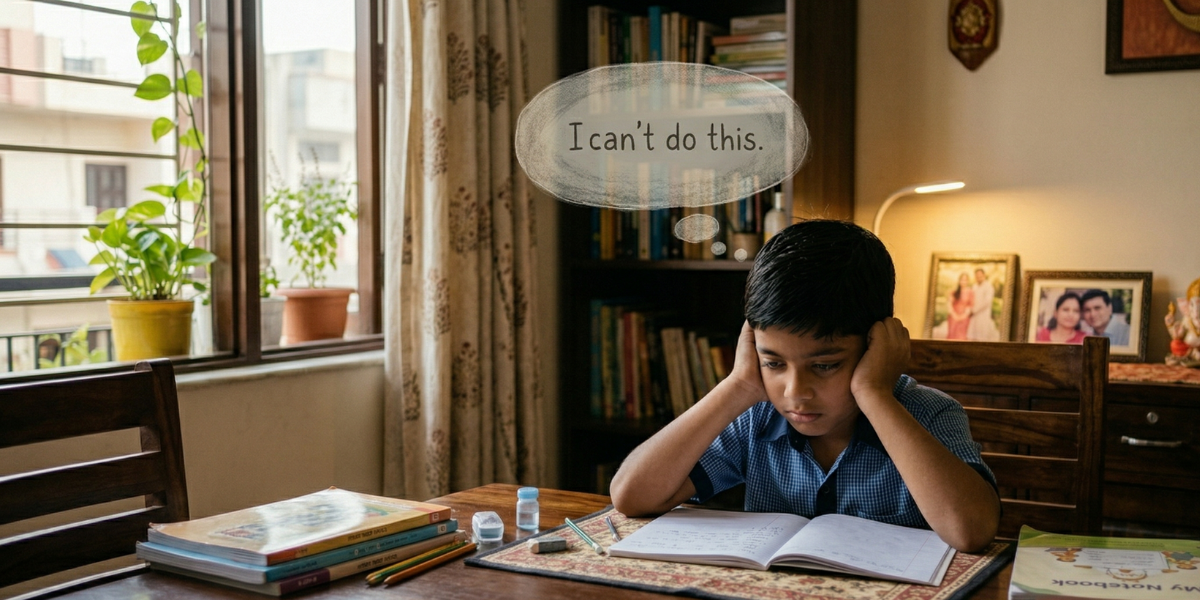
This is the most concerning and dangerous so picking this at 1st place. Pay close attention to how your child talks about themselves about studies. They may say these statements
I am dumb
Everyone else understand this concept except me
I can’t do this
They are not just passing comments. They are warning signs of declining self-confidence.
Over time, this mindset can become deeply ingrained, making it harder to rebuild both skills and their self-belief. Instead of seeing mistakes as part of learning, the child begins to see them as proof of their limitations.
What can you do? Never ignore this and respond with empathy. Reassure your child that struggling is part of learning, and focus on effort rather than outcomes. At the same time, consider getting the right academic support early, with guidance and encouragement. It’s much easier to rebuild confidence before these beliefs become permanent.
#sign2: Low test scores and grades are dropping
Don’t judge your child if they score bad in just one test. It is quite normal that during initial tests students may not score well because of unfamiliar test patterns, new classes and less study, etc. Parents need to understand that sudden drop is quite normal vs gradual drop in grades seems abnormal.
Often parents blame the child instead of finding the root cause.
What to do? Talk to the class teacher first, then look for subject-specific help from teachers. If you are able to connect the dots of distraction then discuss with your child in detail. It may be possible that your child might say that “ I am not able to understand this subject or he/she may say that the class is going quite fast” and find the solution accordingly.
#sign3: Warning or remarks from the school
If a student is not performing well or doesn't have appropriate behaviour in class then school has policies to inform or talk to parents. So, don’t ignore it. This only happens when a teacher has observed something consistently over time.
I also observe in this kind of situation parents feel defensive which is natural. But don’t support your child. Teacher’s feedback is not criticism, it’s a valuable insight and an opportunity to support your child before small challenges become bigger ones. So, what can you do? Schedule meeting with the teacher and approach with an open mind. Listen carefully, ask specific questions and discuss all possible solutions. Work with other family members and create a simple practical plan.
#sign4: Losing interest in studies
Parents often complain that their child was enjoying doing maths or science and now avoiding it completely. Why? You might hear statements like “I hate Maths” or “Science is boring”. Initially this may sound a simple change in preference, but it often goes deeper than that.
It happens when a child struggles to understand concepts, keep up with the pace of the class, or feel left behind. What can you do? Start an open, non-judgemental conversation with your child. Try to understand whether the issue lies with the subject itself or the way it’s being taught. Sometimes, a different teaching approach from an online tuition by experts, extra guidance or personalized attention can reignite their interest and confidence.
#sign5: Homework taking too long
If you observe 30 minutes of homework or studying a chapter stretching into 2-3 hours that it is concerning. It may be because the child is confused about a topic, may be frustrated because he is not able to understand, or struggling to grasp concepts that were already covered in class.
This gives you a clear signal that there is a gap in classroom understanding. Maybe the teacher is quite fast in delivering lectures, or the way of teaching is quite difficult or something else that you have to figure out. What to do in this case? Sit with your child and see where they get stuck. If you are not able to figure it out, ask them what happened and why are you not getting it.
#sign6: Exam depression, anxiety and fear
Children often express their academic anxiety through their body like headache, stomachache, and less sleep. There is a study conducted by US governed body NIH (national library of medicine) conducted among 2000 children aged 10-12 years across various schools. The study reveals 68% of students reporting moderate to severe academic stress and 45% showing moderate to severe anxiety. Also female students have higher stress and anxiety levels compared to males. Major predictors included academic workload, fear of failure, and lack of social support.
Prevalence of stress and anxiety
Category | Total (%) | Boys (%) | Girls (%) |
Mild Stress | 32 | 36 | 28 |
Moderate Stress | 45 | 42 | 48 |
Severe Stress | 23 | 22 | 24 |
Mild Anxiety | 55 | 59 | 51 |
Moderate Anxiety | 30 | 28 | 32 |
Severe Anxiety | 15 | 13 | 17 |
Factors contributing to stress and anxiety
Factor | Stress Prevalence (%) | Anxiety Prevalence (%) |
Academic Workload | 75 | - |
Fear of Failure | 60 | - |
Parental Pressure | 48 | - |
Examination Pressure | - | 65 |
Peer Competition | - | 55 |
Lack of Social Support | 35 | 40 |
What to do? It needs immediate actions to reduce workload. Your child may need counselling, balanced extracurricular activities and most importantly parents do not give the burden to score excellent or hold top 3 positions in exams to children.
#sign7:Child Is Falling Behind the Class Syllabus
This is the clearest sign that a child needs extra academic support is when they start falling behind the class syllabus. You will notice that your child struggles with ongoing chapters because the foundation from previous topics is weak. This is common in subjects like Maths and Science, where each concept builds on the one before. If a single step is missed, everything that follows can start to feel confusing. And why does this happen? There are few reasons where students fall behind the class syllabus.
Weak foundation in basics
Frequent absences due to illness, travel and parents often think “Itna padhke konsa collector banega aaj mat ja school padosi ki shadi me jana hai”
Pace of classroom teaching
Lack of attention
Poor study habits
Distractions and screen time
Lack of support at home
No external
What can you do? Instead of pushing your child to keep up with the current syllabus, help them go back and strengthen the basics. Your child needs structured support and structured guidance. This can be done by arranging additional academic support other than school.
Why your child needs extra academic support: Conclusion

Every parent reading this knows that feeling something is off with your child but you are not sure what exactly. You are not overthinking. You are just paying attention. And that attention is the first step. The truth is, children rarely come and say "Mom, I need help with Maths" or "Dad, I am falling behind in class." They show it through silence, through anger, through avoidance, and sometimes through a stomach ache every Monday morning before school. Your job as a parent is to read those signs before the gap becomes too wide to bridge.
The 7 signs we covered are not a reason to panic. They are a checklist. If you spotted even 2 or 3 of these in your child, don’t think that this is a crisis, it is just a signal that your child needs a little more support than what the school can give in a class of 40 students.
And getting that support is not a sign of failure. It is actually the smartest thing a parent can do.
In 2026, online tuition for school students has completely changed what extra academic support looks like. It is no longer about sending your child to a crowded coaching centre after a long school day. Now, a verified, experienced teacher can connect with your child one on, one from home, at a time that works, in a way that actually matches how your child learns.
At Learnic, we do exactly that. Whether your child needs help in one subject or complete support across the syllabus from Class 3 to Class 12, we have India's top verified teachers ready to help. Our teachers do not just teach the chapter, they find where your child got lost and start from there. Because the goal is not just to finish the syllabus. The goal is to make your child feel "I can do this" again.
If you spotted any of these signs in your child, do not wait for the next exam result to confirm it. Act now, while the gap is still small.

Written by
Niranjan Sharma
Frequently Asked Questions
Find answers to your questions & more.
Average marks are not always the problem. The real question is, is your child actually understanding what is being taught or just somehow managing to pass? If they struggle to explain a concept in their own words, take very long to finish homework, or get very anxious before every exam, these are signs that things are not as fine as they appear. Silent struggling is actually harder to catch than visible struggling.
There is no fixed class or age. But the earlier the better. If your child is in Class 3 or 4 and already showing signs of weak basics in Maths or English, that is the right time to act. Do not wait until Class 9 or 10 when the syllabus becomes heavy and the pressure is high. Small gaps in early classes become big problems in higher classes because subjects like Maths and Science build on previous concepts.
This depends on the child and the quality of the tutor, not the format. A good online tutor who gives personal attention, tracks progress, explains concepts clearly and is available for doubts is far better than a physical tuition class where 20 students sit together and the teacher just reads from the book. In 2026, online tuition for school students has become smarter, more interactive and more flexible. At Learnic, our live one-on-one classes are designed so that the child gets full attention, something that is rarely possible in a physical group class.